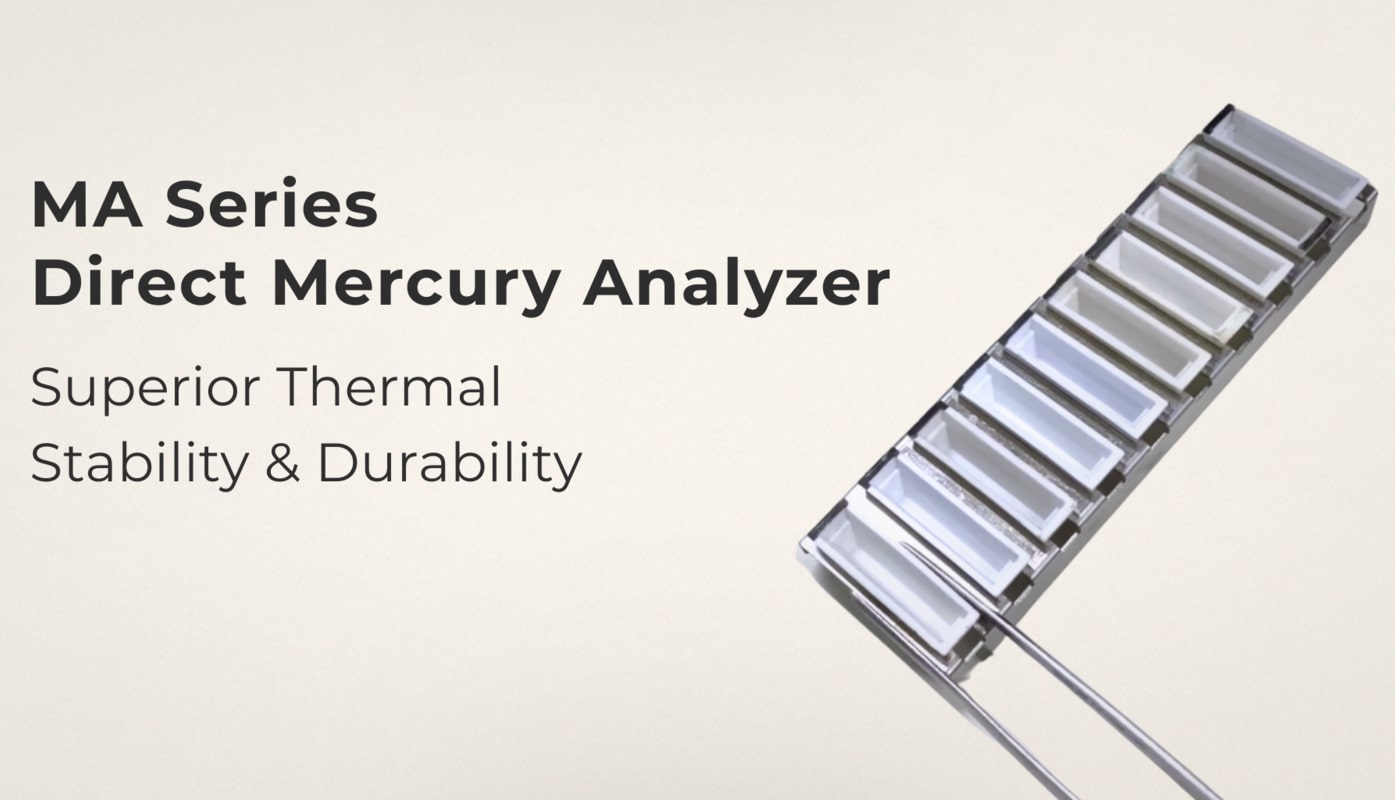
When it comes to mercury analysis, the sample boat plays a role in ensuring precision — because accuracy isn’t just a goal, it’s a necessity. That’s why every detail in the MA-3000 direct mercury analyzer, including the sample boat, is chosen with purpose.
A question we often get from users is: “Why ceramic sample boats?”
Let’s break it down.
The Role of the Sample Boat in Thermal Decomposition
In the MA-3000 direct mercury analyzer, the sample boat holds the sample during the direct thermal decomposition process — where the material is heated to high temperatures to release mercury vapor for detection. As such, the sample boat must withstand extreme heat while remaining chemically inert to avoid interfering with the measurement.
In addition, it must be able to tolerate the full thermal range of the decomposition process, which involves repeated expansion and contraction. This makes the choice of material critical — it must not only endure thermal stress but also retain its structural integrity over time.
Why Ceramic? A Balance of Performance and Cost
Our ceramic boats are specially designed to meet three critical demands:
- Thermal Stability – Withstand rapid and repeated temperature changes without cracking or warping.
- Chemical Inertness – Non-reactive to acidic or alkaline substances, ensuring accurate mercury readings.
- Durability Across Sample Types – Whether it’s high-sulfur coal, mining ore, contaminated soil, or protein-rich materials like seafood, oil-based liquids or even acidic/alkaline aqueous liquids, ceramic boats retain structural integrity over multiple uses.
But here’s the kicker: Ceramic sample boats offer the inertness of quartz — at a much lower cost. This makes them ideal for labs needing reliability and efficiency without overspending on consumables.
What Happens If You Use the Wrong Sample Boat?
Using materials that aren’t inert or thermally stable (like metal or low-grade ceramics) can lead to:
- Cross-contamination / memory-effect
- Ghost peaks in blank measurements
- Cracking under repeated heating cycles
- Compromised data accuracy
Can You Reuse Ceramic Sample Boats?
Yes! With proper care, they can be reused. However, they should be regularly inspected for residue buildup or cracks. Damaged sample boats can lead to data drift or unexpected blank readings.
At NIC, we’ve spent over 50 years refining the details behind every measurement — and the choice of ceramic sample boats in our MA-3000 direct mercury analyzer is no exception. It’s part of our commitment, our TechNIC to providing dependable, cost-effective mercury analysis solutions.
So next time you load a sample, know there’s a lot of TechNIC behind that tiny white tray.
Read our other articles or publications to learn more about mercury analysis
Download a MA-3000 Brochure
FAQs – Ceramic Sample Boats
Ceramic boats are thermally stable, chemically inert, and cost-effective. They perform similarly to quartz but at a fraction of the cost, making them ideal for consistent, accurate mercury analysis across a wide range of sample types.
Yes, ceramic sample boats used in the MA-3000 direct mercury analyzer are reusable. However, they should be inspected visually after each use. If cracks appear or if there is residue buildup affecting blank measurements, the boat should either be replaced or cleaned following NIC’s recommended washing protocol.
If dirt or residual contamination is observed, or if the blank measurement shows unexpected peaks, we recommend applying NIC’s washing protocol. This includes soaking the ceramic boat in diluted acid, rinsing with pure water, and drying it properly before re-use. For detailed steps, please refer to our maintenance manual or contact your local distributor.
Ceramic boats can handle a wide variety of sample types, including soil, mining ores, seafood, food products, fertilizers, oil-based liquids, and materials with high acidity or alkalinity.
Replacement frequency depends on your sample type and how often you run analyses. Generally, ceramic boats should be replaced if they show physical damage or visible residue buildup. That said, from our long-term experience, NIC’s ceramic sample boats are highly durable and can withstand repeated use across a wide variety of sample types — often lasting far longer than expected with proper handling.
Yes. Damaged or contaminated boats can lead to ghost peaks, unstable baselines, or inconsistent results. Routine inspection and timely replacement are essential.
Not necessarily. Some metal boats may expand during the combustion process, especially under high temperatures. We’ve received reports from users of other systems where certain metal boats deformed and became stuck inside the combustion tube. Moreover, under oxygen-rich combustion, metallic oxidation is inevitable, rapidly degrades, and affects the integrity to analysis performance. To avoid these risks, NIC always recommends ceramic sample boats for optimal compatibility, safety, and data integrity and seamless operation.