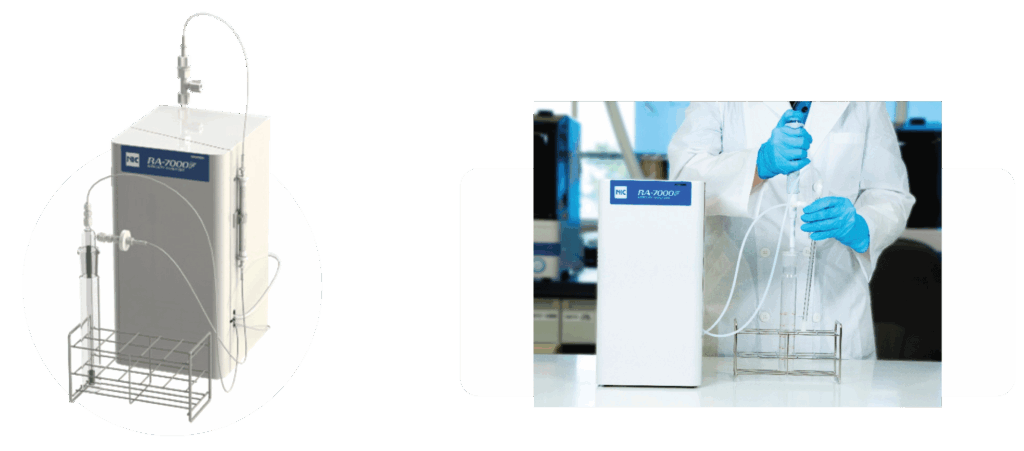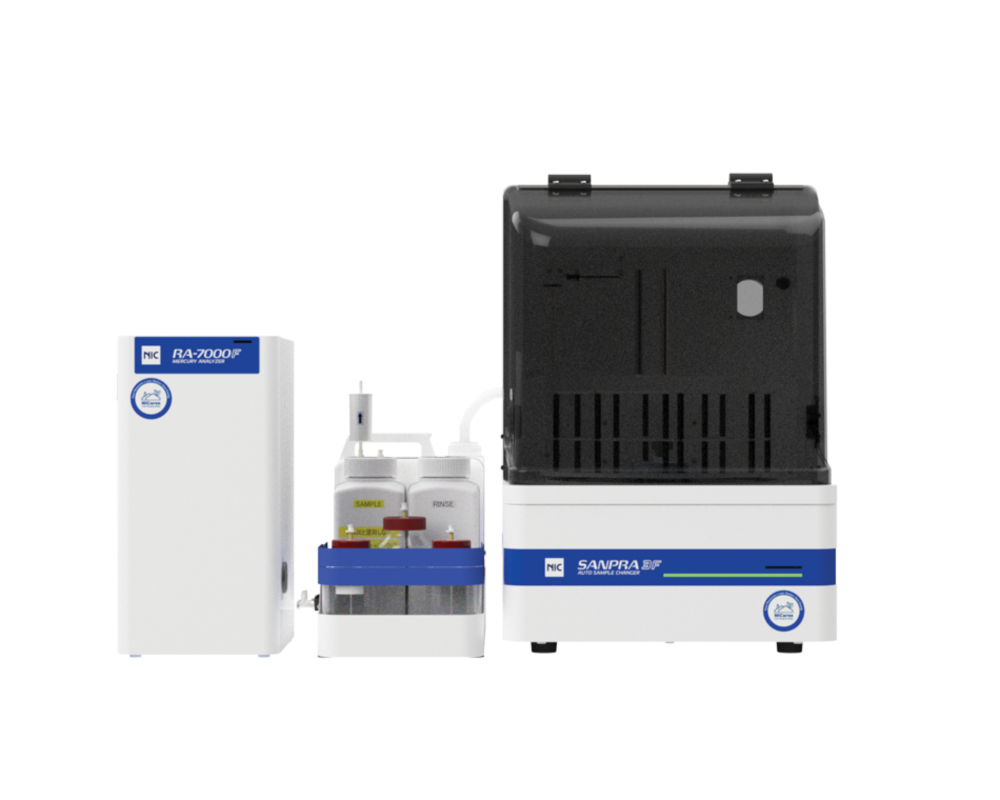
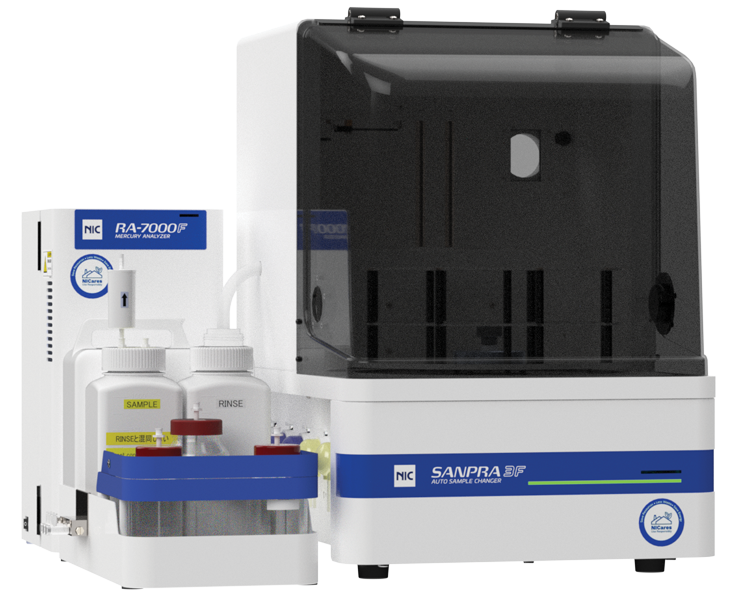
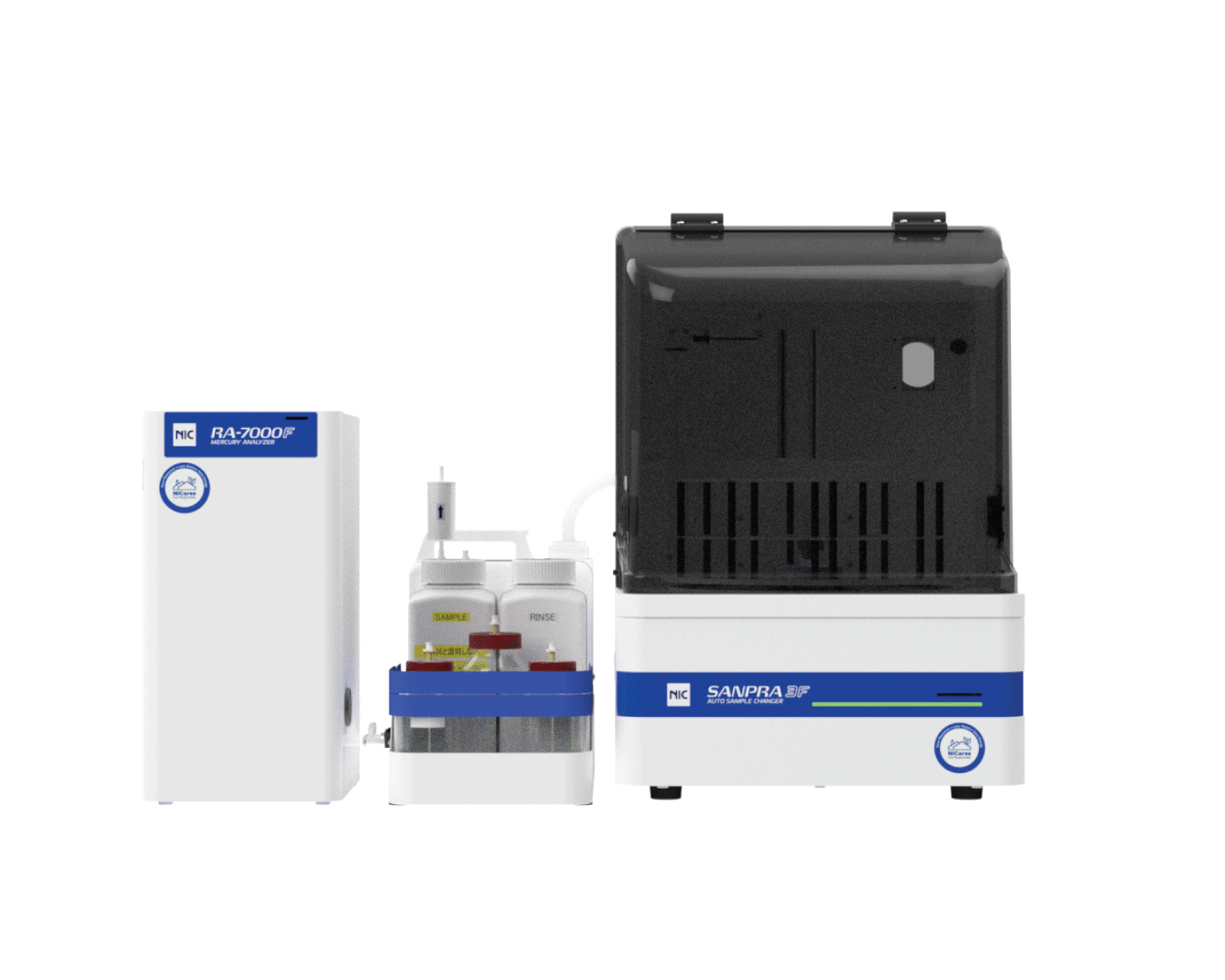
RA-7000F CVAFS Detector
- Detection Limit: ≤ 0.01ppt
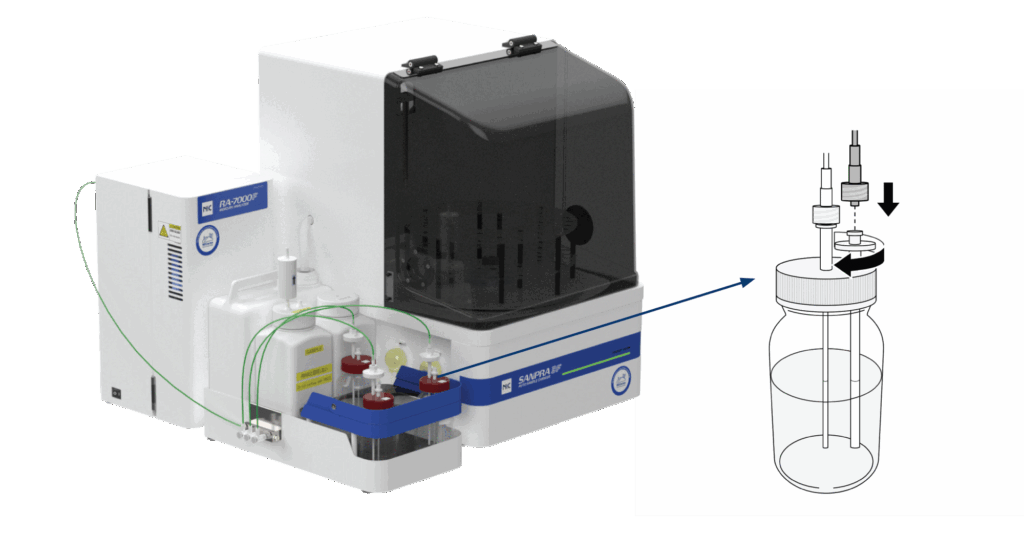
SANPRA™ 3F Autosampler
- 80 sample positions
- 5mL/10mL Sample Volume
- Fully automated analysis in accordance with USEPA 1631E & 245.7, ISO 17852 and more
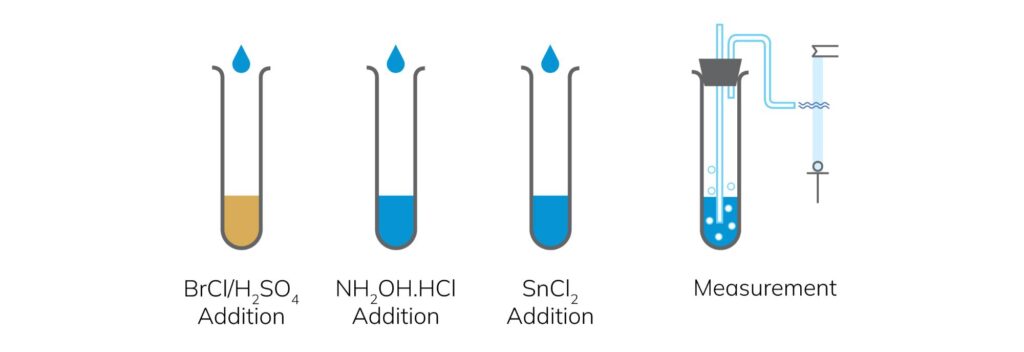
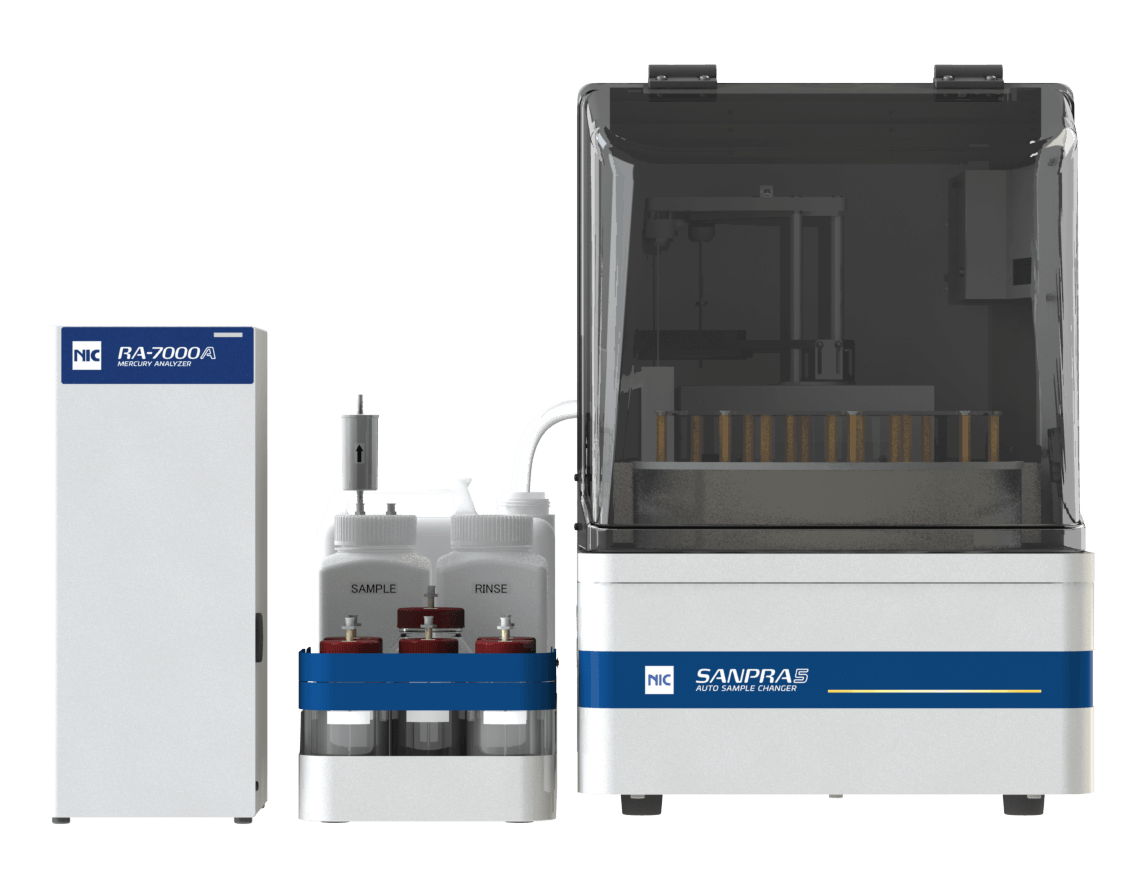
In Direct Mode, the RA-7000F, paired with SANPRA™ 3 Autosampler, enables reagent dispensing and measurement all within the same platform.
SANPRA™ 3 features an 80-position autosampler that allows 5mL (standard) or up to 10mL sample analysis volume for each sample tube. Users can simply pipette 5mL of sample solution into each sample tube or utilize the Auto-level Adjustment function to precisely adjust it to 5mL.
Bromine Monochloride Oxidation:
Within the SANPRA™ 3, the oxidizing agent Bromine Monochloride (BrCl) is dispensed automatically into each sample tube, to complete the oxidation of mercury compounds. The presence of excess BrCl is visually confirmed by its permanent pale-yellow color formation, which must persist throughout the initial 30-minute digestion process.
Sample solutions are left inside the SANPRA™ 3 for digestion and complete oxidation is visually confirmed through the pale-yellow color that remains unchanged within the sample solution.
Quenching by Hydroxylamine Hydrochloride solution:
Next, SANPRA™ 3 adds Hydroxylamine Hydrochloride (NH2OH·HCl) to quench the excess Bromine, followed by a purging step to remove the excess chlorine gas.
Tin (II) Chloride Reducing Vaporization:
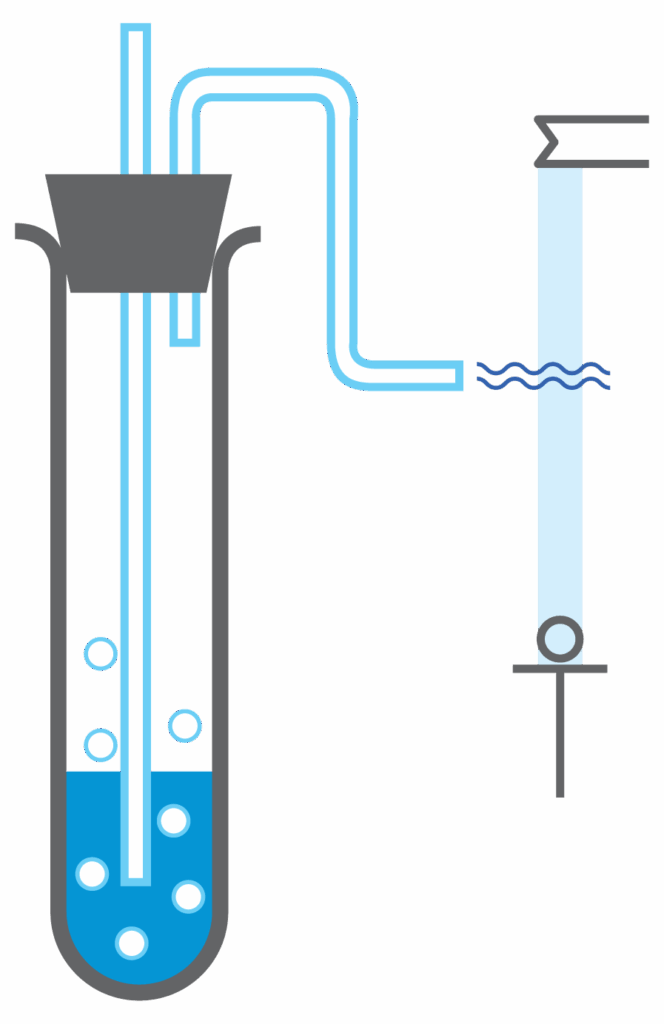
Finally, Tin (II) Chloride (SnCl2) is added to induce reducing vaporization via the Discrete-Direct-Purge (DDP) technique, converting all ionic mercury into elemental mercury (Hg0).
CVAFS Measurement: The sample solution is purged by Argon gas and the elemental mercury (Hg0) vapor is then transferred to the RA-7000F Cold Vapor Atomic Fluorescence Spectrometry (CVAFS) detector for measurement and quantification.

Gold Amalgamation Mode enhances sensitivity and eliminates interferences by trapping and preconcentrating elemental mercury on a collector tube before analysis.
In Gold Amalgamation Mode, the sample solution undergoes:
Bromine Monochloride Oxidation:
Within the SANPRA™ 3, the oxidizing agent Bromine Monochloride (BrCl) is dispensed automatically into each sample tube, to complete the oxidation of mercury compounds. The presence of excess BrCl is visually confirmed from its permanent pale-yellow color formation, which must persist throughout the initial 30-minute digestion process.
Sample solutions are left inside the SANPRA™ 3 for digestion, and complete oxidation is visually confirmed by the pale-yellow color that remains unchanged within the sample solution.
Quenching by Hydroxylamine Hydrochloride solution:
Next, SANPRA™ 3 adds Hydroxylamine Hydrochloride (NH2OH·HCl) to quench the excess Bromine, followed by a purging step to remove the excess chlorine gas.
Tin (II) Chloride Reducing Vaporization:
Finally, Tin (II) Chloride (SnCl2) is added to induce reducing vaporization via the Discrete-Direct-Purge (DDP) technique, converting all ionic mercury into elemental mercury (Hg0).
Gold Amalgamation:
The sample solution is purged by a stream of Argon gas and the elemental mercury (Hg0) vapor is then purged out of solution and trapped, purified and preconcentrated on Mercury Collector Tube (Gold trap) via Gold Amalgamation within the RA-7000F.
CVAFS Measurement:
After Gold Amalgamation, the concentrated and purified elemental mercury vapor is thermally desorbed into the Argon gas stream and sent to the RA-7000F Cold Vapor Atomic Fluorescence Spectrometry (CVAFS) detector for measurement and quantification.
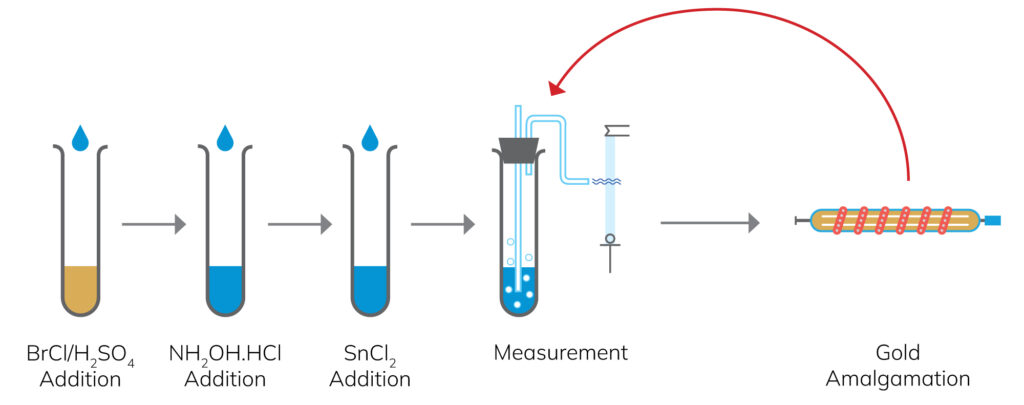
RA-7000F is capable of performing DUAL Mode (Both Direct and Gold Amalgamation Enrichment Mode) in a single measurement. In DUAL Mode, the sample solution undergoes:
Firstly, mercury compounds in the sample solution will undergo the measurement procedure of Direct Mode: Bromine Monochloride Oxidation, Quenching by Hydroxylamine Hydrochloride solution, Tin (II) Chloride Reducing Vaporization followed by CVAFS Measurement.
Right after the 1st measurement, the elemental mercury vapor is redirected to undergo Gold Amalgamation, where the elemental mercury (Hg0) vapor is then trapped, purified and preconcentrated on a mercury collector tube (Gold trap).
2nd CVAFS Measurement: After Gold Amalgamation, the concentrated and purified elemental mercury vapor is thermally desorbed into the Argon gas stream and is sent to the RA-7000F Cold Vapor Atomic Fluorescence Spectrometry (CVAFS) detector for measurement and quantification.

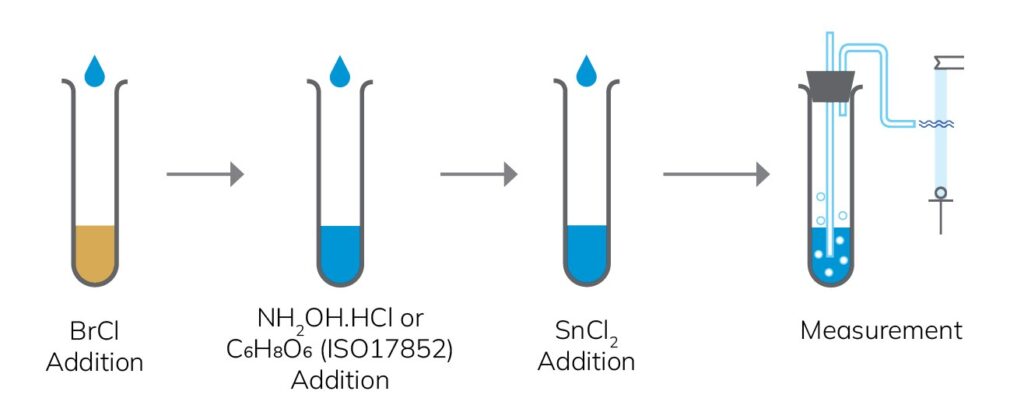
In Direct Mode, the RA-7000F, paired with SANPRA™ 3F Autosampler, enables reagent dispensing and measurement all within the same platform.
SANPRA™ 3F features an 80-position autosampler that allows 5mL (standard) or up to 10mL sample analysis volume for each sample tube. Users can simply pipette the analysis volume of sample solution into each sample tube or utilize the Auto-level Adjustment function to precisely adjust it to its required set analysis volume (5mL to 10mL)
Bromine Monochloride Oxidation:
Within the SANPRA™ 3F, the oxidizing agent Bromine Monochloride (BrCl) is dispensed automatically into each sample tube, to complete the oxidation of mercury compounds. The presence of excess BrCl is visually confirmed from its permanent pale-yellow color formation, which must persist throughout the initial 30-minute digestion process. Once confirmed, the sample solutions are left up to 24 hours inside the SANPRA™ 3F for digestion and complete oxidation is visually confirmed the pale-yellow color remains unchanged within the sample solution.
Quenching by Hydroxylamine Hydrochloride (For EPA245.7 Method) or L-Ascorbic Acid Solution (For ISO17852 Method):
Next, SANPRA™ 3F adds Hydroxylamine Hydrochloride(NH2OH.HCl ) or L-ascorbic solution (C₆H₈O₆) to quench the excess Bromine, followed by a purging step to remove the excess chlorine gas.
Tin (II) Chloride Reducing Vaporization:
Finally, Tin (II) Chloride (SnCl2) is added to induce reducing vaporization via the Discrete-Direct-Purge (DDP) technique, converting all ionic mercury into elemental mercury (Hg0).
CVAFS Measurement: The sample solution is purged by Argon gas and the elemental mercury (Hg0) vapor is then transferred to the RA-7000F Cold Vapor Atomic Fluorescence Spectrometry (CVAFS) detector for measurement and quantification.
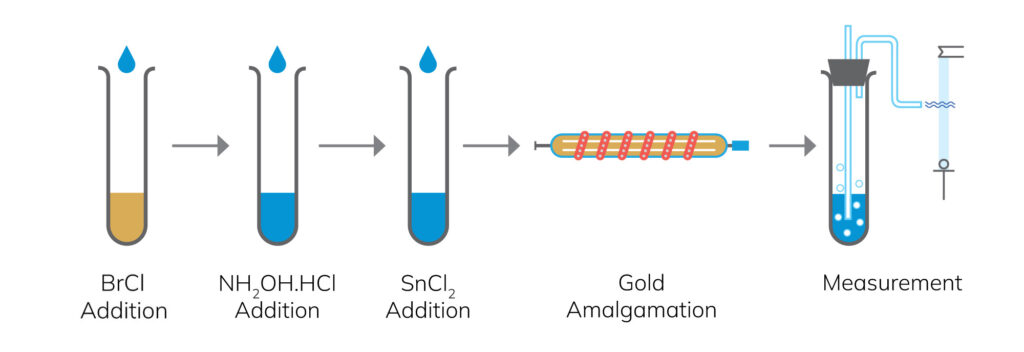
Gold Amalgamation Mode enhances sensitivity and eliminates interferences by trapping and preconcentrating elemental mercury on a collector tube before analysis.
In Gold Amalgamation Mode, the sample solution undergoes:
Bromine Monochloride Oxidation:
Within the SANPRA™ 3F, the oxidizing agent Bromine Monochloride (BrCl) is dispensed automatically into each sample tube, to complete the oxidation of mercury compounds. The presence of excess BrCl is visually confirmed from its permanent pale-yellow color formation, which must persist throughout 12-hours oxidation and digestion process.
Quenching by Hydroxylamine Hydrochloride solution:
Next, SANPRA™ 3F adds Hydroxylamine Hydrochloride (NH2OH·HCl) to quench the excess Bromine, followed by a purging step to remove the excess chlorine gas.
Tin (II) Chloride Reducing Vaporization:
Finally, Tin (II) Chloride (SnCl2) is added to induce reducing vaporization via the Discrete-Direct-Purge (DDP) technique, converting all ionic mercury into elemental mercury (Hg0).
Gold Amalgamation:
The sample solution is purged by a stream of Argon gas and the elemental mercury (Hg0) vapor is then purged out of solution and trapped, purified and preconcentrated on Mercury Collector Tube (Gold trap) via Gold Amalgamation within the RA-7000F.
CVAFS Measurement:
After Gold Amalgamation, the concentrated and purified elemental mercury vapor is thermally desorbed into the Argon gas stream and sent to the RA-7000F Cold Vapor Atomic Fluorescence Spectrometry (CVAFS) detector for measurement and quantification.
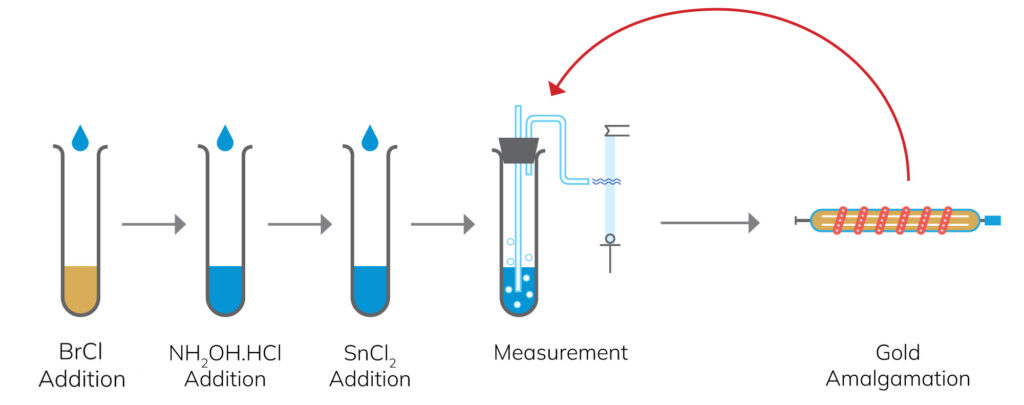
RA-7000F is capable of performing DUAL Mode (Both Direct and Gold Amalgamation Enrichment Mode) in a single measurement. In DUAL Mode, the sample solution undergoes:
Firstly, mercury compounds in the sample solution will undergo the measurement procedure of Direct Mode: Bromine Monochloride Oxidation, Quenching by Hydroxylamine Hydrochloride solution, Tin (II) Chloride Reducing Vaporization followed by CVAFS Measurement.
Right after the 1st measurement, the elemental mercury vapor is redirected to undergo Gold Amalgamation, where the elemental mercury (Hg0) vapor is then trapped, purified and preconcentrated on a mercury collector tube (Gold trap).
2nd CVAFS Measurement: After Gold Amalgamation, the concentrated and purified elemental mercury vapor is thermally desorbed into the Argon gas stream and is sent to the RA-7000F Cold Vapor Atomic Fluorescence Spectrometry (CVAFS) detector for measurement and quantification.
Why Does DUAL Mode Matter?
With unknown samples, selecting the wrong mode/method, not only causes incorrect results, but also loses some precious and limited samples for repeating the test.
The innovative DUAL Mode eliminates the uncertainty of analyzing the sample via both Direct and Gold–Amalgamation Modes in a single measurement, yielding both results to choose from to suit and match the correct measuring range and method.
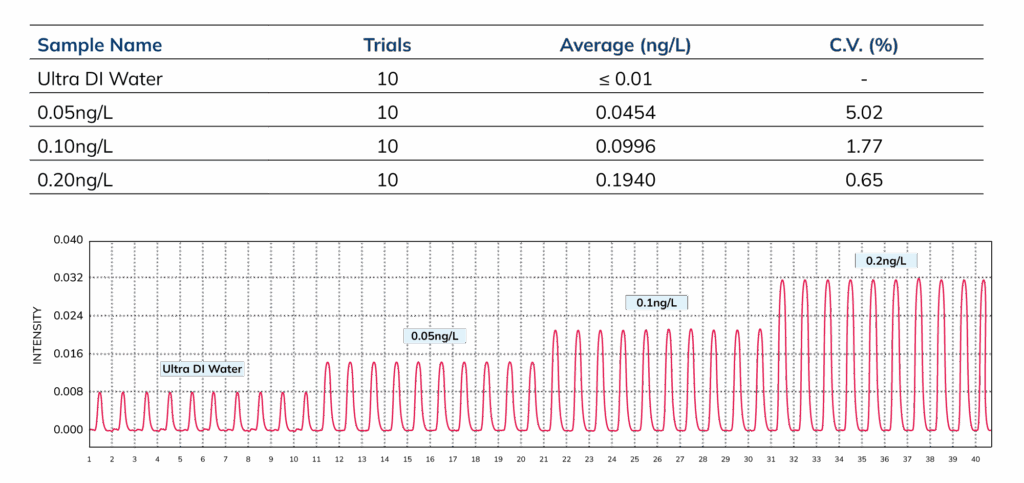
A 500ng mercury sample is analyzed to simulate an extreme high-mercury scenario.
- After measurement, the blank reading in the next run was 1.5656ng.
- Repeated blank measurements returned to baseline within 10 runs, demonstrating rapid recovery.
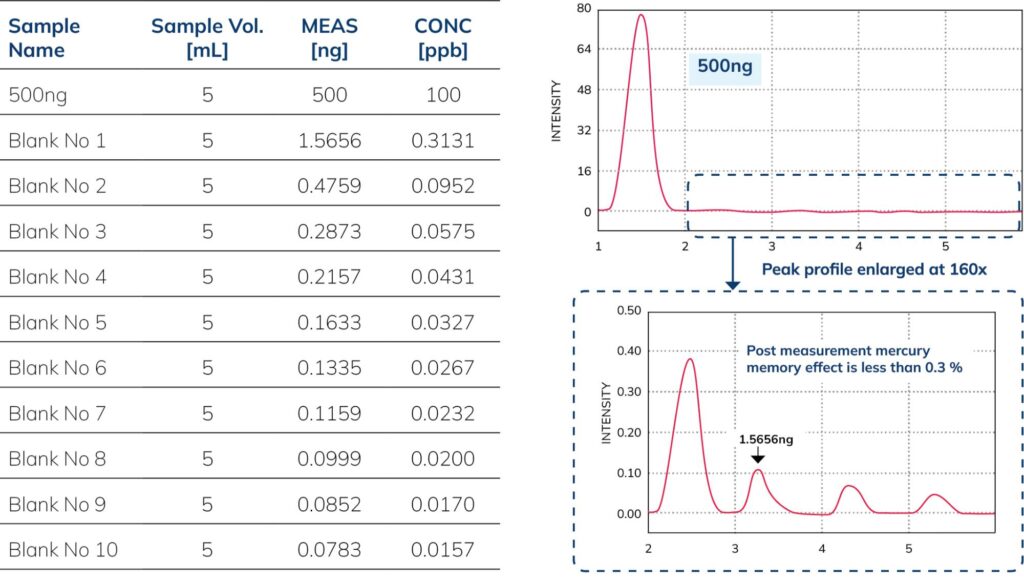
As shown in the data above, post-measurement memory effect of abnormally high mercury measurement 500ng is less than 0.3%. With a proven Discrete Direct Purge Technique in RA-7000F, RA-7000F delivers precise mercury analysis with minimal memory effect, ensuring high sensitivity and accuracy in every measurement.
- Minimize Cross-Contamination: Ensures high-sensitivity analysis remains uncompromised.
- Fast Recovery: Minimal downtime between high and low mercury samples.
- Reliable and Consistent Results: Meets stringent regulatory requirements


- User-Defined QC Criteria: Users can manually input acceptance limits for critical quality control parameters required by either EPA 1631e or EPA 245.7 such as Calibration Blank, CF RSD, CF Recovery, IPR Recovery, MDL, and Method Blanks.
- Customizable QC Actions: Users can choose “Stop” as an action when a criterion is not met, ensuring immediate intervention for non-compliant results.

The Tag column allows users to label and classify measurement data with specific tags, improving tracking and retrieval, and data handling.
The software associates each measurement record with corresponding QC categories based on the assigned tags. All measurements will be automatically verified against the predefined thresholds in QC Criteria.
 After measurement completion, all QC parameters required by USEPA methods (e.g., USEPA 1631E & USEPA 245.7) are automatically compiled in the Post-Measurement Report.
- Automated Report Generation: This report provides a comprehensive summary of compliance status, displaying Pass/Fail results at a glance.
- Error Prevention & Data Integrity: Failed QC parameters are clearly flagged, enabling users to take corrective actions immediately.